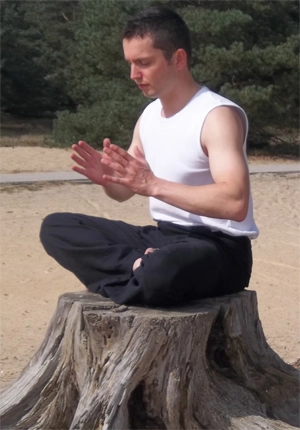
From tension
to relaxation.
I was about eleven. An ordinary afternoon, the same route home from school. But something was different. The light was softer and at the same time clearer. Colours were deeper, scents more intense. Everything seemed still, yet it was humming with life. I felt carried, as if I were becoming one with everything around me. That moment has always stayed with me. Only years later, when I first practised Zhineng Qigong, did I recognise it again. Not with my head, but with my heart. The same stillness. The same sense of connection.
My background is in martial arts, Shaolin Kung Fu. Hard, physical, built on discipline. My Kung Fu teacher was small and slight, yet during one lesson he threw me over his shoulder with such ease that it felt almost magical. Clearly something other than muscle power was at work. I think that is where my fascination with Qi began.
Step by step, Zhineng Qigong let me feel what it means to let strength arise from softness. I was used to being strong through tension. Letting go of that took years. That is how I moved from a martial art to a healing art.
“True strength sinks.
It does not tense,
it takes root.”
I am a certified Zhineng Qigong teacher, but at the moment I do not teach weekly classes or in-depth workshops. I am, however, available as a guest teacher. Get in touch to discuss the possibilities.
Shamanism,
non-dualism
& Zhineng Qigong.
For a long time I walked three paths side by side: Zhineng Qigong, the shamanic path and non-dualism. They spoke different languages and used different images, but to me they pointed to the same essence.
In 2011 I qualified in New Zealand as a Level 1 and Level 2 teacher of Yuan Tze Ren Xue / Zhineng Qigong. In 2020 I completed the Level 1 Yuan Gong certification. Yuan Gong is a new system developed by Yuan Tze, but I soon felt that I still had so much to discover in Zhineng Qigong that I chose to focus on it instead. I am currently deepening my practice of the Level 3 exercises: a layer in which stillness and movement become increasingly hard to tell apart.
Over the years I read widely across many traditions, and the Indian texts of Advaita Vedanta, or non-dualism, fascinated me. The accounts of Ramana Maharshi's life on Mount Arunachala in India touched me in particular, as a truth that would not let me go. I write more about this in my books.
Perhaps it was never three paths. Perhaps it was always one flow.
What remains is simplicity, in the Qigong exercises too. When thoughts fall silent, a direct experience of the present moment arises. In that state there is no one doing the exercise, and yet the exercise is done.
Read more about this in my booksWhat is
Zhineng Qigong?
In the early 1980s, Páng Míng developed a system that spread rapidly across China, partly because the government embraced it as a way to improve public health. But what sets Zhineng Qigong apart from many other movement practices is its combination of simplicity and depth. The exercises are relatively easy to learn, but the layers that open up over time are endless.
At its core is a series of movements and postures, performed in a meditative, relaxed state. Not as a sport, not as fitness, but as attention in motion. Daily practice increases the flow of vital energy, dissolves blockages and improves health, not as a side effect but as a direct result.
Zhineng Qigong includes both dynamic and static exercises. Sometimes you move, sometimes you stand still. You are always present.
Scientific research confirms what practitioners have long sensed: better lung capacity, a healthier heart, stronger bones and improved oxygen uptake at the cellular level. Beyond these physical effects, many practitioners also develop something subtler: focus, calm, and a sense of connection with themselves and with the universe.
The Huáxià Centre in China showed that this is not mere theory. Founded by Páng Míng himself in 1988, it grew into the largest medicine-free hospital in China. More than 300,000 patients with 180 different conditions were treated there, many of them terminally ill and given up on by Western medicine.
It is often said that 95% of the patients were cured, but the reality is more nuanced. That 95% refers to overall effectiveness: everyone who experienced some improvement. Full recovery, depending on how it was measured, ranged from 15% to 35%. Only a fraction, less than 1%, noticed no difference at all. For people with no other options, those are remarkable figures. Imagine what Qigong can do while you are still in reasonably good health.
The centre has since been closed for political reasons, but the results stand.